MSX palette: 15 colours with hex codes

The MSX (TMS9918) palette
MSX computers of the 1980s drew their picture with the Texas Instruments TMS9918 video chip, which makes fifteen colours and a sixteenth that is see-through. The set is bright and a little odd: three greens, three reds, two blues, two yellows, a cyan, a magenta, a grey, black and white.
| Colour | Swatch | Hex | RGB |
|---|---|---|---|
| 1, black | #000000 | 0, 0, 0 | |
| 2, medium green | #0aad1e | 10, 173, 30 | |
| 3, light green | #34c84c | 52, 200, 76 | |
| 4, dark blue | #2b2de3 | 43, 45, 227 | |
| 5, light blue | #514bfb | 81, 75, 251 | |
| 6, dark red | #bd2925 | 189, 41, 37 | |
| 7, cyan | #1ee2ef | 30, 226, 239 | |
| 8, medium red | #fb2c2b | 251, 44, 43 | |
| 9, light red | #ff5f4c | 255, 95, 76 | |
| 10, dark yellow | #bda22b | 189, 162, 43 | |
| 11, light yellow | #d7b454 | 215, 180, 84 | |
| 12, dark green | #0a8c18 | 10, 140, 24 | |
| 13, magenta | #af329a | 175, 50, 154 | |
| 14, grey | #b2b2b2 | 178, 178, 178 | |
| 15, white | #ffffff | 255, 255, 255 |
The colours run in the chip's colour codes, 1 to 15.
To use these colours in another program, copy the list. It is one hex code per line, with no hash, which is the shape most palette pasters want.
000000
0AAD1E
34C84C
2B2DE3
514BFB
BD2925
1EE2EF
FB2C2B
FF5F4C
BDA22B
D7B454
0A8C18
AF329A
B2B2B2
FFFFFFAbout MSX (TMS9918)
MSX was a standard for home computers, announced in 1983 and made by many companies. The first generation drew with the TMS9918 family of chips, which also appear in other machines of the time. The chip's colour code 0 means transparent, so the screen colour or a picture behind shows through. The other fifteen are listed here.
- The numbers on this page are the chip's own colour codes, 1 to 15. Code 0, transparent, is not a colour and is not listed.
- The chip has three reds and three greens, so a shadow and a highlight for each is built in.
- Magenta (#AF329A) is the odd one out. It is the only purple on the chip, so it is worth keeping for something special.
Use it in the editor
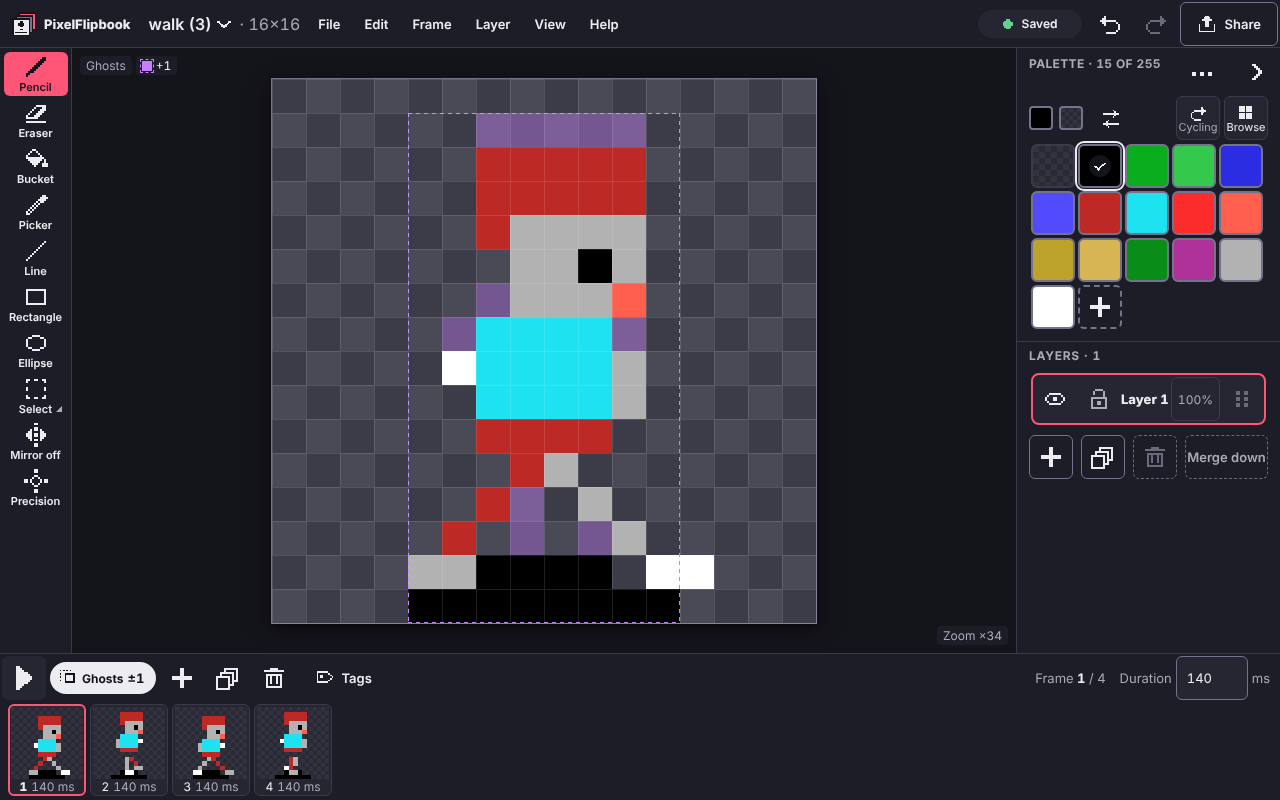
The easy way is the link under the animation at the top of this page: Open it in the editor with this palette opens a little walker as your own copy, with all 15 colours loaded. Clear the canvas or draw over it and the palette stays. The original is never changed, and each time you open it you get a new project.
To put the palette into a sprite you already have, paste the list.
- Copy the hex list above.
- Open the editor and open the palette menu, the three dots at the top of the palette panel.
- Choose Paste hex list and paste. The editor says how many colours it found: 15 here.
- Choose Add to put the colours after the ones you have, or Replace to swap your palette for this one, and press the button at the bottom. A line shows what will change first, for example how many pixels change colour. The whole change is one step, so Undo takes it back.
How the sample was made
The sample is the Walk starter, which is drawn in the PICO-8 palette. It was opened in the editor, the hex list was pasted with Paste hex list and applied with Replace, and the GIF was exported from the editor. Replace swaps each colour for the nearest colour in the new palette, measured as the distance between the two colours in red, green and blue. So the sample shows what you would get, not a touched-up version. Sometimes the nearest colour is not the one you would pick by eye, and that is where you step in and fix a few pixels.
The picture is 16 by 16 pixels, with each pixel drawn as a block of 8 by 8 on screen, so the edges are sharp.
Tips for this palette
- The two yellows, dark (#BDA22B) and light (#D7B454), are muted, almost gold. Use them for sand and wood, not for lights.
- Cyan (#1EE2EF) is the brightest colour here. A little of it reads as glow.
- Black is the only true black, so outline in dark blue (#2B2DE3) or dark green (#0A8C18) if you want a softer line.
Where it comes from
The values on this page are the 15 colours of the TMS9918 video chip as listed in the Wikipedia article "TMS9918". Source: Wikipedia, "TMS9918", the gamma-corrected colour table, built from Texas Instruments, TMS9918A/TMS9928A/TMS9929A Video Display Processors Data Manual (November 1982), Table 2.3 "Color Assignments".
The article converts the data manual's brightness and colour figures to RGB with a gamma of 1.6, and corrects the red of "light red" from 113% to 100%. Colour code 0 is transparent and is not a colour, so it is not listed.
TMS9918 is a Texas Instruments part and MSX is the name of a computer standard, and PixelFlipbook is not affiliated with Texas Instruments, the MSX Association or Wikipedia. Colour values are facts about hardware, not artwork, and each one here is taken or computed as described above, and from nowhere else.
Lospec, the palette site that most pixel artists know, lists many more palettes, each with its author named. Find more at Lospec. The editor's Browse palettes button reads that list directly when you open it, so authors are credited where they published. Palettes from Lospec are not copied onto this site. We found no licence for reuse in Lospec's terms, so every palette here comes from the named hardware source instead.
Other palettes here: Apple II palette, Master System palette, and the palette index. To edit, import or keep colours exact, read the palettes guide.