Apple II palette: 16 lo-res colours with hex codes

The Apple II lo-res palette
The Apple II lo-res screen showed sixteen colours in big square blocks. Its set is lively and slightly strange: two greys, a deep red, a purple, a brown, an orange, and a pink and an aquamarine that few other machines had.
| Colour | Swatch | Hex | RGB |
|---|---|---|---|
| 0, black ($0000) | #000000 | 0, 0, 0 | |
| 1, deep red ($0D03) | #dd0033 | 221, 0, 51 | |
| 2, dark blue ($0009) | #000099 | 0, 0, 153 | |
| 3, purple ($0D2D) | #dd22dd | 221, 34, 221 | |
| 4, dark green ($0072) | #007722 | 0, 119, 34 | |
| 5, dark gray ($0555) | #555555 | 85, 85, 85 | |
| 6, medium blue ($022F) | #2222ff | 34, 34, 255 | |
| 7, light blue ($06AF) | #66aaff | 102, 170, 255 | |
| 8, brown ($0850) | #885500 | 136, 85, 0 | |
| 9, orange ($0F60) | #ff6600 | 255, 102, 0 | |
| 10, light gray ($0AAA) | #aaaaaa | 170, 170, 170 | |
| 11, pink ($0F98) | #ff9988 | 255, 153, 136 | |
| 12, light green ($01D0) | #11dd00 | 17, 221, 0 | |
| 13, yellow ($0FF0) | #ffff00 | 255, 255, 0 | |
| 14, aquamarine ($04F9) | #44ff99 | 68, 255, 153 | |
| 15, white ($0FFF) | #ffffff | 255, 255, 255 |
The colours run in the lo-res colour register order, 0 to 15, as in the note's table.
To use these colours in another program, copy the list. It is one hex code per line, with no hash, which is the shape most palette pasters want.
000000
DD0033
000099
DD22DD
007722
555555
2222FF
66AAFF
885500
FF6600
AAAAAA
FF9988
11DD00
FFFF00
44FF99
FFFFFFAbout Apple II lo-res
The Apple II came out in 1977. Its low-resolution graphics drew the screen as 40 columns by 48 rows of coloured blocks, in sixteen colours. The original machine made its colours by timing a signal for a colour TV, so the exact shades depended on the TV. The Apple IIgs, from 1986, can draw the same sixteen with real RGB signals, and Apple's technical note number 63 lists the value of each.
- The values are the IIgs ones, so they are what a IIgs shows. A real Apple II on a real TV looked different and no two TVs agreed.
- The note lists each colour as a 12-bit number such as $0D03. The table below gives it next to the colour name, so you can check the conversion yourself.
- Brown (#885500) and orange (#FF6600) are the warm pair, and light green (#11DD00) is the one vivid green.
Use it in the editor
The easy way is the link under the animation at the top of this page: Open it in the editor with this palette opens a little walker as your own copy, with all 16 colours loaded. Clear the canvas or draw over it and the palette stays. The original is never changed, and each time you open it you get a new project.
To put the palette into a sprite you already have, paste the list.
- Copy the hex list above.
- Open the editor and open the palette menu, the three dots at the top of the palette panel.
- Choose Paste hex list and paste. The editor says how many colours it found: 16 here.
- Choose Add to put the colours after the ones you have, or Replace to swap your palette for this one, and press the button at the bottom. A line shows what will change first, for example how many pixels change colour. The whole change is one step, so Undo takes it back.
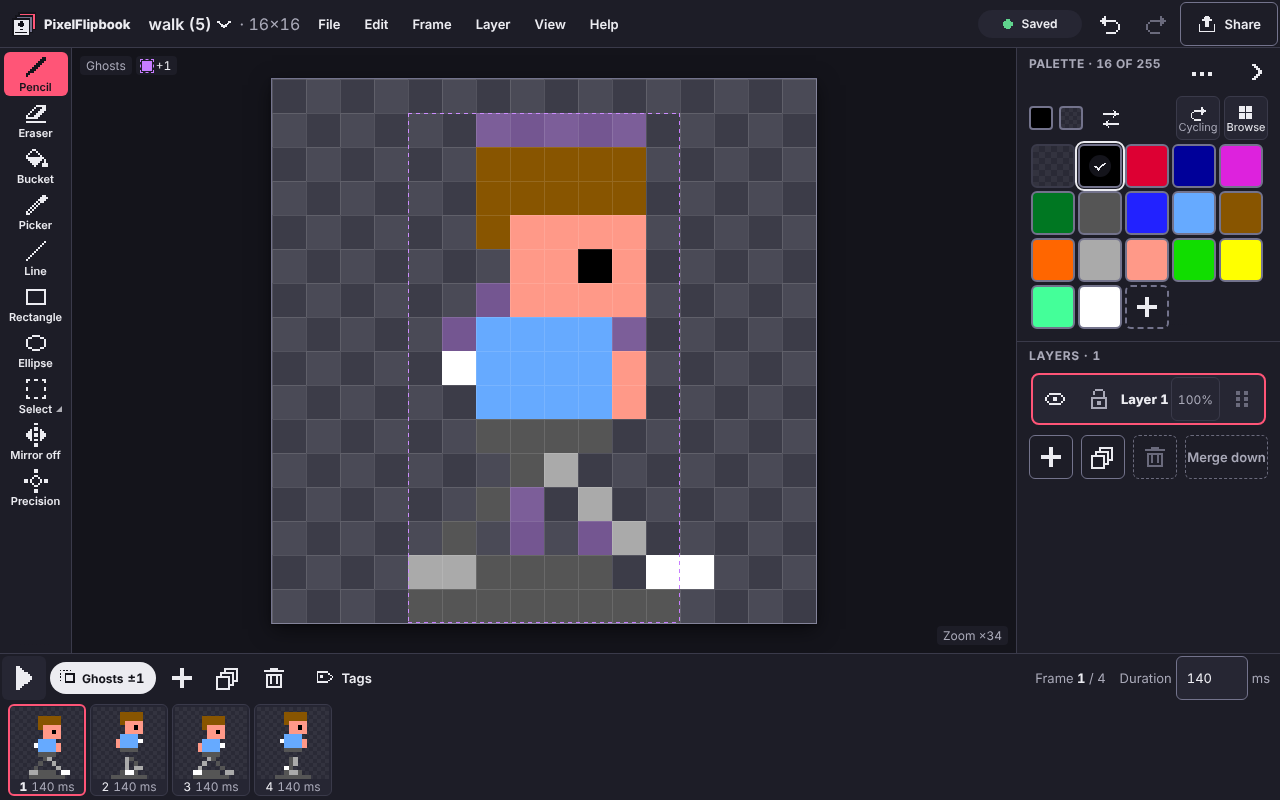
How the sample was made
The sample is the Walk starter, which is drawn in the PICO-8 palette. It was opened in the editor, the hex list was pasted with Paste hex list and applied with Replace, and the GIF was exported from the editor. Replace swaps each colour for the nearest colour in the new palette, measured as the distance between the two colours in red, green and blue. So the sample shows what you would get, not a touched-up version. Sometimes the nearest colour is not the one you would pick by eye, and that is where you step in and fix a few pixels.
The picture is 16 by 16 pixels, with each pixel drawn as a block of 8 by 8 on screen, so the edges are sharp.
Tips for this palette
- The two greys, #555555 and #AAAAAA, with black and white make a clean four step ramp.
- Blocks are the point. Draw big, flat shapes and let the colours do the work.
- Pink (#FF9988) is a good skin tone for a sprite this small, and aquamarine (#44FF99) a good water.
Where it comes from
The values on this page are the 16 lo-res colours as Apple's own technical note gives them for the Apple IIgs. Source: Apple, "Apple IIgs Technical Note #63: Master Color Values" (Jim Luther, July 1989; revised by Dave Lyons, May 1991), Table 1.
The note gives each colour as a 12-bit value with four bits for red, green and blue. This page turns each four-bit step into 8 bits by multiplying it by 17, so $F becomes FF and $D becomes DD.
Apple and Apple II are trademarks of Apple Inc., and PixelFlipbook is not affiliated with Apple. Colour values are facts about hardware, not artwork, and each one here is taken or computed as described above, and from nowhere else.
Lospec, the palette site that most pixel artists know, lists many more palettes, each with its author named. Find more at Lospec. The editor's Browse palettes button reads that list directly when you open it, so authors are credited where they published. Palettes from Lospec are not copied onto this site. We found no licence for reuse in Lospec's terms, so every palette here comes from the named hardware source instead.
Other palettes here: C64 palette, CPC palette, and the palette index. To edit, import or keep colours exact, read the palettes guide.