Sega Master System palette: 64 colours with hex codes

The Sega Master System palette
The Sega Master System can make sixty-four colours: four levels each of red, green and blue. That is a regular grid, so every hue has a smooth ramp from dark to bright, and black to white has four steps with colour all around them.
| Colour | Swatch | Hex | RGB |
|---|---|---|---|
| 0, $00 | #000000 | 0, 0, 0 | |
| 1, $01 | #550000 | 85, 0, 0 | |
| 2, $02 | #aa0000 | 170, 0, 0 | |
| 3, $03 | #ff0000 | 255, 0, 0 | |
| 4, $04 | #005500 | 0, 85, 0 | |
| 5, $05 | #555500 | 85, 85, 0 | |
| 6, $06 | #aa5500 | 170, 85, 0 | |
| 7, $07 | #ff5500 | 255, 85, 0 | |
| 8, $08 | #00aa00 | 0, 170, 0 | |
| 9, $09 | #55aa00 | 85, 170, 0 | |
| 10, $0A | #aaaa00 | 170, 170, 0 | |
| 11, $0B | #ffaa00 | 255, 170, 0 | |
| 12, $0C | #00ff00 | 0, 255, 0 | |
| 13, $0D | #55ff00 | 85, 255, 0 | |
| 14, $0E | #aaff00 | 170, 255, 0 | |
| 15, $0F | #ffff00 | 255, 255, 0 | |
| 16, $10 | #000055 | 0, 0, 85 | |
| 17, $11 | #550055 | 85, 0, 85 | |
| 18, $12 | #aa0055 | 170, 0, 85 | |
| 19, $13 | #ff0055 | 255, 0, 85 | |
| 20, $14 | #005555 | 0, 85, 85 | |
| 21, $15 | #555555 | 85, 85, 85 | |
| 22, $16 | #aa5555 | 170, 85, 85 | |
| 23, $17 | #ff5555 | 255, 85, 85 | |
| 24, $18 | #00aa55 | 0, 170, 85 | |
| 25, $19 | #55aa55 | 85, 170, 85 | |
| 26, $1A | #aaaa55 | 170, 170, 85 | |
| 27, $1B | #ffaa55 | 255, 170, 85 | |
| 28, $1C | #00ff55 | 0, 255, 85 | |
| 29, $1D | #55ff55 | 85, 255, 85 | |
| 30, $1E | #aaff55 | 170, 255, 85 | |
| 31, $1F | #ffff55 | 255, 255, 85 | |
| 32, $20 | #0000aa | 0, 0, 170 | |
| 33, $21 | #5500aa | 85, 0, 170 | |
| 34, $22 | #aa00aa | 170, 0, 170 | |
| 35, $23 | #ff00aa | 255, 0, 170 | |
| 36, $24 | #0055aa | 0, 85, 170 | |
| 37, $25 | #5555aa | 85, 85, 170 | |
| 38, $26 | #aa55aa | 170, 85, 170 | |
| 39, $27 | #ff55aa | 255, 85, 170 | |
| 40, $28 | #00aaaa | 0, 170, 170 | |
| 41, $29 | #55aaaa | 85, 170, 170 | |
| 42, $2A | #aaaaaa | 170, 170, 170 | |
| 43, $2B | #ffaaaa | 255, 170, 170 | |
| 44, $2C | #00ffaa | 0, 255, 170 | |
| 45, $2D | #55ffaa | 85, 255, 170 | |
| 46, $2E | #aaffaa | 170, 255, 170 | |
| 47, $2F | #ffffaa | 255, 255, 170 | |
| 48, $30 | #0000ff | 0, 0, 255 | |
| 49, $31 | #5500ff | 85, 0, 255 | |
| 50, $32 | #aa00ff | 170, 0, 255 | |
| 51, $33 | #ff00ff | 255, 0, 255 | |
| 52, $34 | #0055ff | 0, 85, 255 | |
| 53, $35 | #5555ff | 85, 85, 255 | |
| 54, $36 | #aa55ff | 170, 85, 255 | |
| 55, $37 | #ff55ff | 255, 85, 255 | |
| 56, $38 | #00aaff | 0, 170, 255 | |
| 57, $39 | #55aaff | 85, 170, 255 | |
| 58, $3A | #aaaaff | 170, 170, 255 | |
| 59, $3B | #ffaaff | 255, 170, 255 | |
| 60, $3C | #00ffff | 0, 255, 255 | |
| 61, $3D | #55ffff | 85, 255, 255 | |
| 62, $3E | #aaffff | 170, 255, 255 | |
| 63, $3F | #ffffff | 255, 255, 255 |
The colours run in colour number order, $00 to $3F, the order the chip uses.
To use these colours in another program, copy the list. It is one hex code per line, with no hash, which is the shape most palette pasters want.
000000
550000
AA0000
FF0000
005500
555500
AA5500
FF5500
00AA00
55AA00
AAAA00
FFAA00
00FF00
55FF00
AAFF00
FFFF00
000055
550055
AA0055
FF0055
005555
555555
AA5555
FF5555
00AA55
55AA55
AAAA55
FFAA55
00FF55
55FF55
AAFF55
FFFF55
0000AA
5500AA
AA00AA
FF00AA
0055AA
5555AA
AA55AA
FF55AA
00AAAA
55AAAA
AAAAAA
FFAAAA
00FFAA
55FFAA
AAFFAA
FFFFAA
0000FF
5500FF
AA00FF
FF00FF
0055FF
5555FF
AA55FF
FF55FF
00AAFF
55AAFF
AAAAFF
FFAAFF
00FFFF
55FFFF
AAFFFF
FFFFFFAbout Sega Master System
The Master System came out in the mid 1980s and drew its picture with a video chip built on the same design as the TMS9918. A game picked its colours from the 64 and could show up to 32 of them at once. Most games used far fewer in any one picture.
- The colour numbers are written $00 to $3F. The two lowest bits of the number are the red level, the next two the green, and the top two the blue.
- The four greys are $00 (#000000), $15 (#555555), $2A (#AAAAAA) and $3F (#FFFFFF).
- Four levels is enough for a smooth shadow in any hue: step down one level in each channel and you have a darker, matching colour.
Use it in the editor
The easy way is the link under the animation at the top of this page: Open it in the editor with this palette opens a little walker as your own copy, with all 64 colours loaded. Clear the canvas or draw over it and the palette stays. The original is never changed, and each time you open it you get a new project.
To put the palette into a sprite you already have, paste the list.
- Copy the hex list above.
- Open the editor and open the palette menu, the three dots at the top of the palette panel.
- Choose Paste hex list and paste. The editor says how many colours it found: 64 here.
- Choose Add to put the colours after the ones you have, or Replace to swap your palette for this one, and press the button at the bottom. A line shows what will change first, for example how many pixels change colour. The whole change is one step, so Undo takes it back.
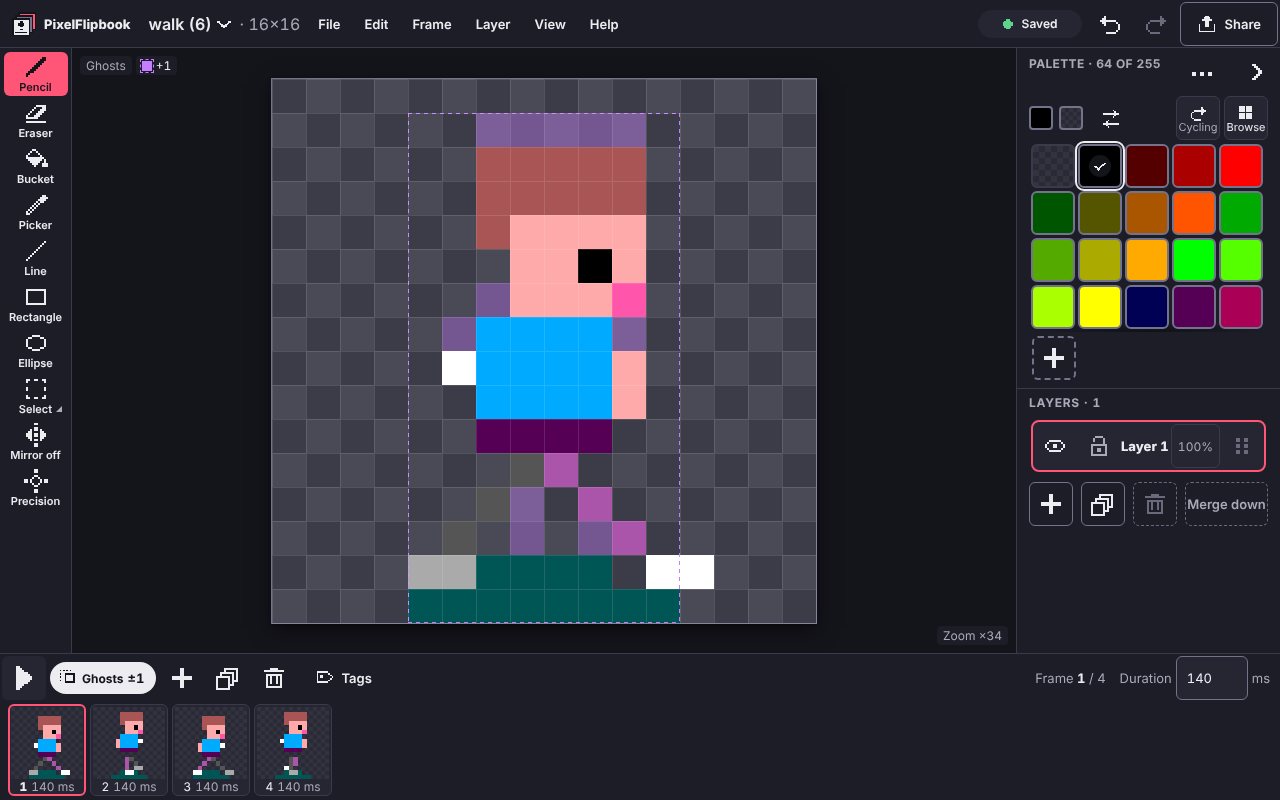
How the sample was made
The sample is the Walk starter, which is drawn in the PICO-8 palette. It was opened in the editor, the hex list was pasted with Paste hex list and applied with Replace, and the GIF was exported from the editor. Replace swaps each colour for the nearest colour in the new palette, measured as the distance between the two colours in red, green and blue. So the sample shows what you would get, not a touched-up version. Sometimes the nearest colour is not the one you would pick by eye, and that is where you step in and fix a few pixels.
The picture is 16 by 16 pixels, with each pixel drawn as a block of 8 by 8 on screen, so the edges are sharp.
Tips for this palette
- Do not use all sixty-four. Pick sixteen that work together first, as a Master System game had to, then stay inside them.
- A ramp is one channel stepping up: #550000, #AA0000, #FF0000 is a red in three steps, and #FF5555 is its light.
- For skin, #FFAA55 and #FF5500 are an easy light and shadow pair.
Where it comes from
The values on this page are the 64 colours that the Master System video chip can make, computed from the %00BBGGRR layout at the levels implied by the colours SMS Power! lists. Source: SMS Power!, "Palette" (smspower.org, Development section): colours are packed as %00BBGGRR, two bits each; the 16 TMS9918-compatible colours it lists imply the four levels.
Two bits a channel give four levels. The 16 colours SMS Power! lists in hex imply the levels 00, 55, AA and FF, and the 64 on this page are computed from the %00BBGGRR layout at those four levels, so they are worked out here, not copied one by one. SMS Power! also notes that the Mark III and SMS1 video chip shows the first blue level slightly brighter than this. The names are the colour numbers a program writes, from $00 to $3F.
Sega and Master System are trademarks of Sega, and PixelFlipbook is not affiliated with Sega or SMS Power. Colour values are facts about hardware, not artwork, and each one here is taken or computed as described above, and from nowhere else.
Lospec, the palette site that most pixel artists know, lists many more palettes, each with its author named. Find more at Lospec. The editor's Browse palettes button reads that list directly when you open it, so authors are credited where they published. Palettes from Lospec are not copied onto this site. We found no licence for reuse in Lospec's terms, so every palette here comes from the named hardware source instead.
Other palettes here: CPC palette, MSX palette, and the palette index. To edit, import or keep colours exact, read the palettes guide.